We have broadly 4 types of audiences in our mind who might find this framework useful:
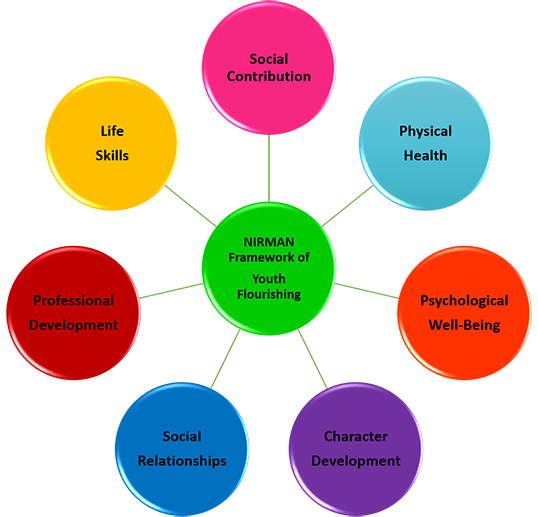
We look forward to a future where young people's growth and progress in life is gauged and facilitated, by themselves and others, on such a diverse landscape of flourishing and does not remain restricted to exam scores, package figures, vehicles owned and square feet of purchased property.
Absence of mental or physical illness does not automatically mean presence of good health (4,24). It merely means that we are not on the negative side of the axis but at the zero point. There are myriad possibilities of growing on the positive side of the axis. We hope this framework will serve as a useful guide in this exciting journey! Flourishing Youth will be a real marker of a Flourishing India!
References:
1. State of World Population 2014 : Fact Sheet - Youth in Asia | United Nations Population Fund [Internet]. [cited 2025 Aug 14].
2. Bloom DE., Canning David, Sevilla Jaypee. The demographic dividend : a new perspective on the economic consequences of population change. Rand; 2003. 106 p. ,
3. Patton GC, Sawyer SM, Santelli JS, Ross DA, Afifi R, Allen NB, et al. Our future: a Lancet commission on adolescent health and wellbeing. Vol. 387, The Lancet. Lancet Publishing Group; 2016. p. 2423–78.
4. Keyes CLM. The mental health continuum: From languishing to flourishing in life. J Health Soc Behav. 2002;43(2):207–22.
5. Sen A. Development as Freedom. New York: Alfred Knopf; 1999.
6. Huppert FA, So TTC. Flourishing Across Europe: Application of a New Conceptual Framework for Defining Well-Being. Soc Indic Res [Internet]. 2011 Feb 1 [cited 2025 Aug 14];110(3):837.
7. Emerging adulthood. A theory of development from the late teens through the twenties - PubMed [Internet]. [cited 2025 Aug 14].
8. Seligman MEP, Csikszentmihalyi M. Positive psychology. An introduction. Am Psychol [Internet]. 2000 [cited 2025 Aug 14];55(1):5–14.
9. Constitution of the World Health Organization [Internet]. [cited 2025 Aug 14].
10. Ryff CD. Happiness is everything, or is it? Explorations on the meaning of psychological well-being. J Pers Soc Psychol. 1989 Dec;57(6):1069–81.
11. Masten AS. Ordinary magic. Resilience processes in development. Am Psychol [Internet]. 2001 [cited 2025 Aug 14];56(3):227–38.
12. Cui P, Mao Y, Shen Y, Ma J. Moral Identity and Subjective Well-Being: The Mediating Role of Identity Commitment Quality. Int J Environ Res Public Health [Internet]. 2021 Sep 1 [cited 2025 Aug 14];18(18):9795.
13. Narvaez D, Lapsley DK. Chapter 8 Moral Identity, Moral Functioning, and the Development of Moral Character. Psychology of Learning and Motivation - Advances in Research and Theory. 2009 Jan 1;50(C):237–74.
14. CLONINGER CR. Character Strengths and Virtues: A Handbook and Classification. American Journal of Psychiatry [Internet]. 2005 Apr 1 [cited 2025 Aug 14];162(4):820-a-821.
15. Coleman JS. Social Capital in the Creation of Human Capital. Vol. 94, Source: The American Journal of Sociology.
16. Baumeister RF, Leary MR. The need to belong: Desire for interpersonal attachments as a fundamental human motivation. Psychol Bull [Internet]. 1995 [cited 2025 Aug 14];117(3):497–529.
17. Deci EL, Ryan RM. The “what” and “why” of goal pursuits: Human needs and the self-determination of behavior. Psychol Inq [Internet]. 2000 [cited 2025 Aug 18];11(4):227–68.
18. Palmer AN, Patel M, Narendorf SC, Sledge S, Sanchez K. Changes in flourishing from adolescence to young adulthood: An 8-year follow-up. Child Fam Soc Work. 2023 Feb 1;28(1):194–209.
19. Ghadiri Bahramabadi F, Manee FM, Issazadegan A. The effect of life skills training on psychological well-being and satisfaction among female adolescents. Vol. 5, Journal of Research & Health Social Development & Health Promotion Research Center. 2015.
20. Astin AW, Sax LJ, Avalos J. Long-Term Effects of Volunteerism During the Undergraduate Years [Internet]. Vol. 22, The Review of Higher Education. 1999.
21. Damon W, Menon J, Bronk KC. The development of purpose during adolescence. Appl Dev Sci. 2003 Jul 1;7(3):119–28.
22. Weinstein N, Ryan RM. When Helping Helps: Autonomous Motivation for Prosocial Behavior and Its Influence on Well-Being for the Helper and Recipient. J Pers Soc Psychol. 2010 Feb;98(2):222–44.
23. Vidal C, Silverman J, Petrillo EK, Lilly FRW. The health promoting effects of social flourishing in young adults: A broad view on the relevance of social relationships. Social Science Journal [Internet]. 2022 [cited 2025 Aug 18];59(2):221–35.
24. Huber M, André Knottnerus J, Green L, Van Der Horst H, Jadad AR, Kromhout D, et al. How should we define health? BMJ (Online). 2011 Jul 30;343(7817).
25. Irish LA, Kline CE, Gunn HE, Buysse DJ, Hall MH. The role of sleep hygiene in promoting public health: A review of empirical evidence. Sleep Med Rev [Internet]. 2015 Aug 1 [cited 2025 Oct 15];22:23–36.
26. Warburton DER, Bredin SSD. Health benefits of physical activity: a systematic review of current systematic reviews. Curr Opin Cardiol [Internet]. 2017 Sep 1 [cited 2025 Oct 15];32(5):541–56.
27. Healthy diet [Internet]. [cited 2025 Oct 15].
28. Mohamad Kamal NF binti, bin Shafie AAH, Othman K binti, bin Mokhtar AN, bin Wahab S. Drug and Substance Abuse among Youth: Factors, Effects and Prevention Methods. International Journal of Academic Research in Business and Social Sciences. 2024 Jul 16;14(7).
29. Reddy K, Arora R, Rathi V, Humaid M, Agrawal D, Jain T. A Study on the Implications of Addiction on the Youth of India [Internet]. Vol. 4, International Journal of Humanities Social Science and Management (IJHSSM).
30. Sexual health [Internet]. [cited 2025 Oct 15].
31. Krug EG, Mercy JA, Dahlberg LL, Zwi AB. The world report on violence and health. Lancet [Internet]. 2002 Oct 5 [cited 2025 Oct 15];360(9339):1083–8.
32. Gross JJ. Emotion Regulation: Current Status and Future Prospects. Psychol Inq. 2015 Jan 2;26(1):1–26.
33. Ryff CD, Singer BH. Know thyself and become what you are: A eudaimonic approach to psychological well-being. J Happiness Stud [Internet]. 2008 Jan 5 [cited 2025 Oct 15];9(1):13–39.
34. Deci EL, Ryan RM. Self-determination theory: A macrotheory of human motivation, development, and health. Canadian Psychology. 2008 Aug;49(3):182–5.
35. Chatterjee A, Baid M, Sinha P, Golechha S, Akshaya I. Influence of Mindfulness on Self-Esteem and Psychological Well-Being—A Study on Young Adults. Studies in Systems, Decision and Control [Internet]. 2025 [cited 2025 Oct 15];236:513–21.
36. Mindset: The new psychology of success. [Internet]. [cited 2025 Oct 15].
37. Patel V, Saxena S, Lund C, Thornicroft G, Baingana F, Bolton P, et al. The Lancet Commission on global mental health and sustainable development. The Lancet [Internet]. 2018 Oct 27 [cited 2025 Oct 15];392(10157):1553–98.
38. Diener E, Oishi S, Tay L. Advances in subjective well-being research. Nat Hum Behav [Internet]. 2018 Apr 1 [cited 2025 Oct 15];2(4):253–60.
39. Damon W. The Path to Purpose: How Young People Find Their Calling in Life. 2008;
40. Aquino K, Reed AI. The self-importance of moral identity. J Pers Soc Psychol [Internet]. 2002 [cited 2025 Oct 15];83(6):1423–40.
41. Passi V, Johnson N. The impact of positive doctor role modeling. Med Teach. 2016 Nov 1;38(11):1139–45.
42. The Oxford Character Project | Character Education in Universities: A… [Internet]. [cited 2025 Oct 15].
43. Salgado D, Carrillo S, Gómez Y, Mesurado B. Character education and virtues development as a path to human flourishing beyond borders. 2025 [cited 2025 Oct 15]
44. Educating for Eudaimonia: A radical pedagogy of flourishing - Dr Kevin Smith - Cardiff University [Internet]. [cited 2025 Oct 15].
45. Laursen B, Collins WA. Parent—Child Relationships During Adolescence. Handbook of Adolescent Psychology. 2009 Oct 30;
46. Sanika Patil M. The Influence of Family Structure on Resilience, Emotional Regulation, and Maladaptive Thought Patterns in Young Adults: A Comparative Study of Divorced and Non-Divorced Families. [cited 2025 Oct 15];12(2).
47. Pei R, Zaki J, Grimes B, Whitney J, Boyle L. Connecting with others How social connections improve the happiness of young adults.
48. Barry CMN, Madsen SD, Nelson LJ, Carroll JS, Badger S. Friendship and romantic relationship qualities in emerging adulthood: Differential associations with identity development and achieved adulthood criteria. J Adult Dev [Internet]. 2009 Nov [cited 2025 Oct 15];16(4):209–22.
49. Verma R, Sekar S, Mukhopadhyay S. Unlocking flourishing at workplace: An integrative review and framework. Applied Psychology [Internet]. 2025 Feb 1 [cited 2025 Oct 15];74(1):e12591
50. Brewer MB, Gardner W. Who Is This “We”? Levels of Collective Identity and Self Representations. J Pers Soc Psychol. 1996;71(1):83–93.
51. Lent RW. Career Development and Counseling: A Social Cognitive Framework.
52. Eyler J. The Power of Experiential Education. Liberal Education. 2009;95(4):24–31.
53. Boeder J, Fruiht V, Hwang S, Blanco G, Chan T. Learning to Love, Work, and Live Your Best Life: Mentoring in Emerging Adulthood Predicts Later Flourishing and Subjective Well-Being. Emerging Adulthood [Internet]. 2022 [cited 2025 Oct 17]
54. GUIDING PRINCIPLES FOR BUILDING SOFT SKILLS AMONG ADOLESCENTS AND YOUNG ADULTS. 2017;
55. Orlando C, Oxenham A, Bajorek Z, Smith B, Van Sluijs E, Wilson S, et al. Supporting healthy lifestyles among young adults in the workplace Institute for Employment Studies. 2024;
56. Range: Why Generalists Triumph in a Specialized world [Internet]. [cited 2025 Oct 17].
57. De-Juanas A, Bernal Romero T, Goig R. The Relationship Between Psychological Well-Being and Autonomy in Young People According to Age. Front Psychol [Internet]. 2020 Dec 10 [cited 2025 Oct 17];11:559976.
58. LeBaron-Black AB, Kelley H, Sorgente A. Flourishing and Floundering Financially in Emerging Adulthood: A Handbook. Flourishing and Floundering Financially in Emerging Adulthood: A Handbook [Internet]. 2025 Feb 19 [cited 2025 Oct 17];1–432.
59. Kazak Z, Lochbaum M, Canpolat AM. Flourishing in Young Adults: The Role of Achievement Goals, Participation Motivation, and Self-Perception Levels in Physical Activity Contexts. Sustainability 2021, Vol 13, Page 7450 [Internet]. 2021 Jul 2 [cited 2025 Oct 17];13(13):7450.
60. Bang A, Gupta A. Sevagram to Shodhgram.
61. Youniss J, McLellan JA, Yates M. What We Know About Engendering Civic Identity [Internet]. 1997.